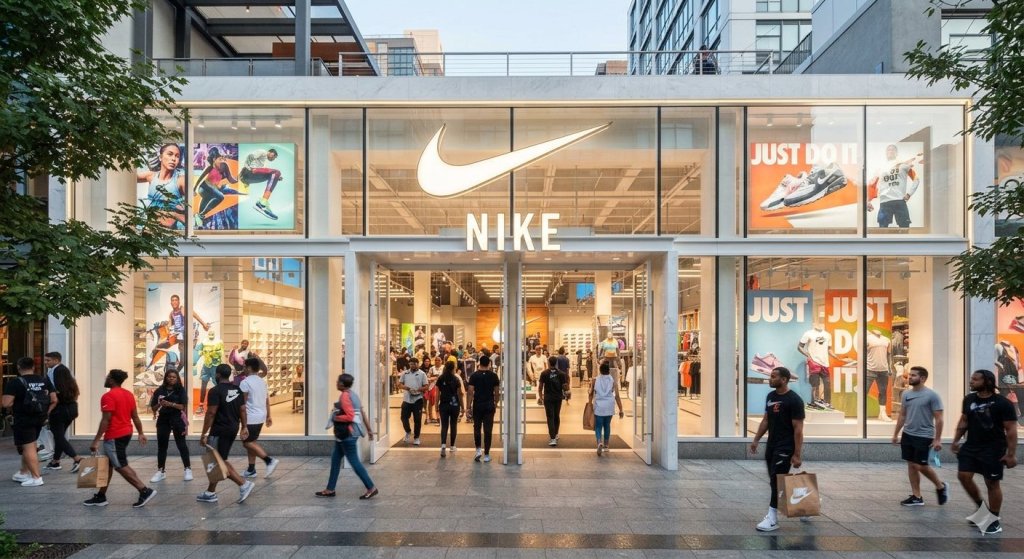
The sportswear company leaves the blue-chip index it joined in December 2008 and keeps its place in the S&P 500.
Nike exits the S&P 100 on Monday, Sept. 21, closing a run of nearly 18 years in the index as S&P Dow Jones Indices completes its quarterly rebalance before the U.S. stock market opens.
The index provider announced the change on Sept. 4. Nike first joined the S&P 100 in December 2008. The S&P 100 is a curated group of 100 large U.S. companies drawn from the broader S&P 500, and S&P Dow Jones Indices describes its quarterly adjustments as a way to keep each index representative of its market capitalization range. Nike remains in the S&P 500.
Nike Exits the S&P 100 as Technology Steps In
Three other companies leave alongside Nike. Colgate-Palmolive, Simon Property Group and Honeywell Aerospace are removed on the same date. Fortune reported that Dell Technologies, Palo Alto Networks, Arista Networks and Sandisk take the open seats, all four from the information technology sector, a shift the publication connects to a growing emphasis on servers and data infrastructure in the blue-chip index.
Nike’s place in the S&P 100 had long rested on its standing as an industry leader more than on its size, according to The Motley Fool, which calculates that Nike now ranks 213th by weight among S&P 500 companies. Each of the four newcomers sits in the top 50 of the S&P 500 by market value.
The direct effect on investors looks modest. Vested Finance calculates that Nike makes up roughly 0.15% of the iShares S&P 100 ETF, the largest fund tracking the index, which holds about $20 billion in assets. That works out to around $30 million in shares, a small figure against the 17 million to 20 million Nike shares that typically change hands on an average day.
The Turnaround, in Nike’s Own Numbers
Nike reported fiscal 2026 revenue of $46.4 billion for the year ended May 31, flat on a reported basis and down 2% on a currency-neutral basis, according to the company’s fourth quarter and full-year results. Wholesale revenue rose 6% to $27.5 billion, while NIKE Direct, the company’s own stores and digital channels, fell 6% to $17.7 billion. For the fourth quarter alone, revenue was $11.0 billion, down 1% as reported and 4% on a currency-neutral basis, with wholesale up 4% to $6.6 billion and NIKE Direct down 7% to $4.1 billion. Within NIKE Direct, digital sales fell 12%, and Nike-owned stores declined 4%. Converse declined 31% to $1.2 billion, and Jordan Brand revenue came in at $7.0 billion, down 3%.

North America was the brightest region, with fiscal 2026 revenue of $20.5 billion, up 5%. Europe, the Middle East and Africa contributed $12.6 billion, up 3% as reported and down 3% on a currency-neutral basis. Greater China remains the steepest climb, with full-year revenue of $5.8 billion, down 13% on a currency-neutral basis. Fourth quarter sales there fell 17% on that measure, and Fortune counts eight consecutive quarters of declining sales in that market, where Nike also faces competition from Chinese brands such as Anta and Li Ning and from international rivals including Hoka and On.
Fourth quarter earnings per share came in at $0.72, a figure that includes a $0.52 benefit from the expected recovery of tariffs paid under the International Emergency Economic Powers Act. Full-year diluted earnings per share were $2.10, down 3%. Full-year gross margin was 42.9%, up 20 basis points, and the fourth quarter margin of 49.2% included a lift of roughly 900 basis points from the same expected tariff recovery. Inventories ended the fiscal year at $7.5 billion, flat with a year earlier, and Nike returned about $2.5 billion to shareholders, including $2.4 billion in dividends, up 5%.
Chief executive Elliott Hill said in the release that the company made structural improvements during the year to lay the groundwork for what Nike calls its Sport Offense, and that the focus now is consistent execution and improved profitability while top-line headwinds continue. Fortune reports that the turnaround has leaned on rebuilding wholesale relationships, reducing excess inventory and returning the brand’s emphasis to performance products, and that Nike has cautioned revenue will keep declining into the first half of fiscal 2027.
What the Market Has Priced In
Nike’s market value peaked near $264 billion in November 2021, when shares traded at $179.10. It stands at roughly $57 billion today, a decline of about 78%, with shares near $38, according to Fortune.
Morningstar analyst David Swartz told Front Office Sports that the exit is mildly embarrassing but of little consequence, adding that it should not affect Nike’s business or its stock price. Because Nike keeps its place in the S&P 500, funds that track that broader benchmark face no change tied to Monday’s move.
Where Nike Stands Heading Into Monday
Nike, based near Beaverton, Oregon, released those results on June 30. Its stated priorities are consistent execution, improved profitability and scaling its wins, with encouragement drawn from progress in performance product. Monday’s rebalance changes which benchmark lists Nike, and the company’s own numbers, together with its S&P 500 membership, remain the fuller measure of the turnaround.