
by Andrea Walker
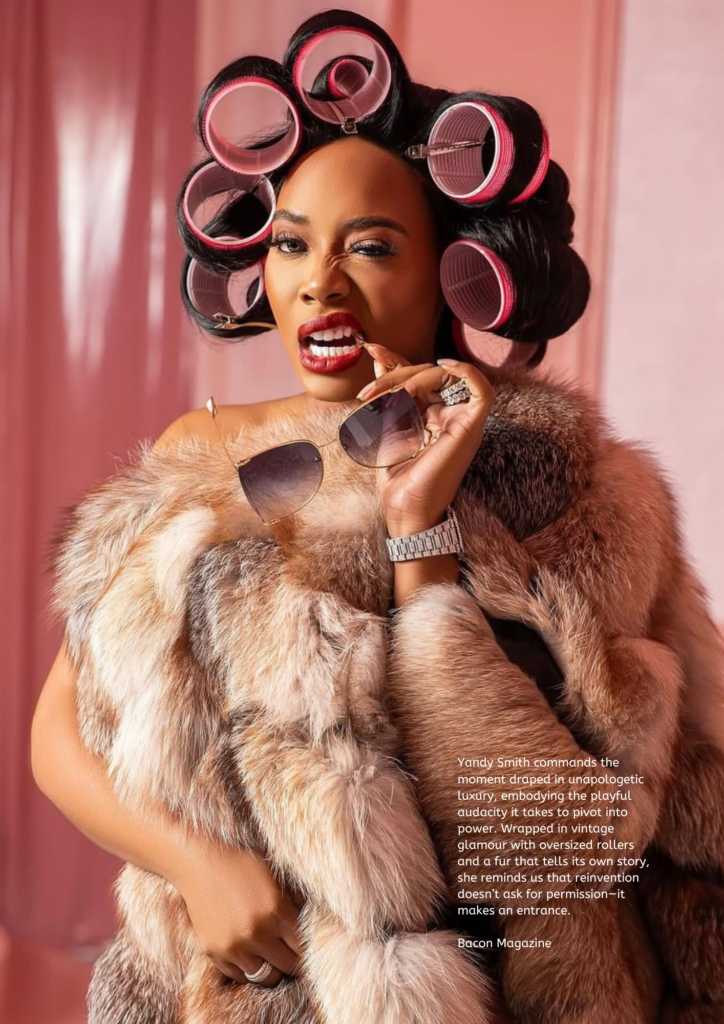
Yandy Smith knows how to play the long game. Before television captured glimpses of her life, before headlines and red carpets, she was already a force behind some of hip-hop’s biggest stars — managing tours and operations for legends like Missy Elliott, Busta Rhymes, and Jim Jones. Her work wasn’t just about securing the next deal — it was about building empires before the world even knew her name.
That early discipline — honed under the weight of multimillion-dollar productions, demanding schedules, and meticulous brand management — still shapes the businesswoman she is today.
Now, Smith leads with the same precision, overseeing a growing portfolio that includes her inclusive Yelle Skincare brand, Atlanta restaurant ventures like Dancing Crêpe and Cliché.
When Bacon Magazine caught up with her, she was fresh from a landmark moment: a high-profile activation celebrating the success of Yelle Skincare. And while reality television brought her into millions of living rooms, Yandy has masterfully used that platform as a marketing engine — amplifying her real work, her businesses, and her activism, rather than letting the screen define her.
Throughout our conversation, it became clear: Yandy’s story isn’t about being seen. It’s about building legacy. She moves with a rare kind of purpose — one rooted in intentionality, fueled by resilience, and sharpened by the quiet pivots most people never see.
In this exclusive interview, Yandy Smith opens up about her earliest lessons from the music industry, the realities of reality TV, balancing motherhood with entrepreneurship, and why the ability to pivot — even when it’s painful — has been the cornerstone of her empire.

Bacon Magazine: You’ve worked with some of the biggest names in music — from Missy Elliott to Busta Rhymes and Jim Jones. When you look back at those early years in the industry, what lessons did you carry into the woman you are today?
Yandy Smith: Oh my goodness, so much. One of my first major projects was with Missy Elliott, and working with her changed everything I thought I knew about management. Missy wasn’t just an artist — she was an entire production on her own. Thirty-two dancers. Multiple DJs. Engineers.
A glam team. Dietary needs. Even magic tricks on stage. My job was to make sure every single piece — from the dancers’ break schedules to the soundboard — was flawless. Managing a tour like that taught me discipline, foresight, and humility. Some days I was making sure the lighting cues hit perfectly; other days I was making sure dancers got their lunch on time so we didn’t violate agency contracts.
That experience shaped the way I run everything now — from my businesses to my household. It’s about building a system where even the smallest details are honored. When you manage a production at that level, managing a restaurant or a skincare line becomes a natural extension. Every piece matters.
Bacon Magazine: When you transitioned from artist management into reality television, how did you protect your narrative, knowing the final edit wasn’t always in your hands?
Yandy Smith: You really can’t control everything. I learned early on that the producers can only use what you give them. If I weren’t fighting, they couldn’t edit a fight in. If I weren’t cursing someone out, they couldn’t create that scene. So I was always mindful of what energy I brought into a room.
Even when there was drama, I insisted the backdrop was my store, my restaurant, or a business space. They might cut out the parts where I talked for fifteen minutes about a launch or a new product, but you’d still see the work in the background.

I treated it like a job — and with any job, you have to show up as your best self, even when it’s hard. Reality TV gave me a platform, yes. But it never defined me. It just gave me another avenue to build.
Bacon Magazine: Speaking of brands and backdrops, Bloomingdale’s and your skincare brand Yelle, can you tell us more about how that opportunity unfolded?
Yandy Smith: That Bloomingdale’s moment was so special because it wasn’t just handed to me. I earned it. I started with a pop-up — one small room. I called in all my friends — Shamea Morton, Porsha Williams, and Kandi Burruss — and asked them to pull up and support. We turned that weekend into over $30,000 in sales.
Bloomingdale’s called the next day, asking if I could come back. Then they asked to carry my line permanently. That showed me the power of our community when we come together. And it showed me that no matter what room they put you in, if you show up prepared and with intention, you can turn a temporary opportunity into a permanent seat at the table.
Bacon Magazine: What motivated you to create Yelle Skincare?
Yandy Smith: I created Yelle during one of the hardest seasons of my life. My husband was leaving, and every visible sign of stress showed up on my skin. I went into stores looking for products, but nothing seemed made for women like me. The price points were outrageous, and none of the branding reflected women of color.
I wanted a line that felt inclusive — something that worked for all women but showed representation. You’ll see Asian women, Black women, Latina women, and Muslim women with hijabs in my marketing. It’s about visibility. It’s about affordability. And it’s about creating skincare that actually supports women through stressful times, because stress shows up on your skin before anything else.
Bacon Magazine: Let’s shift gears a bit — you’re also building a restaurant empire. Tell us about Cliché and Dancing Crêpe.
Yandy Smith: The restaurant world has been such an exciting pivot for me. Dancing Crêpe came first — we focused on fun, casual eats with a twist. Cliché is my latest baby — a three-level space in Atlanta that offers Southern comfort food during the day and transforms into a lounge at night.
You’ll find everything from seafood eggrolls to jerk chicken to lamb chops. We’re open from noon until 3 a.m., and it’s all about creating a full experience — amazing food, great energy, and a space for our community to gather.
Bacon Magazine: As a mother, a wife, and a CEO, what does “balance” really look like for you?
Yandy Smith: Honestly? I don’t believe in balance. I believe in prioritizing.
Some days, my babies get 80% of me because I’m home doing homework, cooking, and being present. Other days, like today, work gets 80% of me because I left the house at 10 a.m. and still haven’t made it home.
I’ve learned to give myself grace. Balance isn’t about everything being equal every day. It’s about being intentional about your priorities. And it’s about protecting your free time — whether that’s spending time with my kids or shutting the door and binge-watching a show.
Bacon Magazine: How has your definition of success evolved over the years?
Yandy Smith: When I was younger, it was all about money. Stacking it. Chasing it. Living on tour, being ready to jump at 3 a.m. if someone called with a business issue.
But when I had my son, my entire perspective shifted. Success now means building a legacy. It means creating businesses that my children can inherit. It means showing up for my community. And it means not missing the milestones that matter most.
Bacon Magazine: You’ve been active on the frontlines of activism. What drives your commitment to community work?
Yandy Smith: It’s love — plain and simple. Love for my people. Love for my children. Love for the future. Once you really see what’s happening — injustice, inequality, systemic harm — you can’t stay silent. You have to use your voice.
Activism, for me, is just another form of building, just like my businesses. It’s about creating safe spaces, building legacy, and protecting what matters most.
Bacon Magazine: This issue is called The Great Pivot. What does pivoting mean to you right now?
Yandy Smith: Pivoting is about survival and growth. It’s knowing when to shift — when something is no longer serving you spiritually, emotionally, or financially.
Sometimes pivoting hurts. Sometimes it means walking away from things that are profitable but draining. But not everything is meant for every season.
I built my life to pivot. When skincare sales slow down after the holidays, my restaurants pick up. When TV slows, my real estate ventures move forward. It’s about having multiple streams and multiple paths — because the goal isn’t just to survive the seasons. It’s to thrive in them.