


By Andrea Walker
Sloane Stephens has never been one for half swings. At nineteen, she stunned Serena Williams en route to the 2013 Australian Open semifinals, announcing herself as a fearless new voice in American tennis. Four years later—after a foot injury dropped her to world No. 957—she stormed back to capture the 2017 US Open, becoming the first unseeded woman to win the title in the Open Era and vaulting to a career-high world No. 3 ranking the following summer. Eight WTA singles trophies, a Miami Open crown, a French Open final, and a Fed Cup victory cemented her legacy as an athlete who turns adversity into altitude.
Yet victory speeches were never the endgame. Stephens, now thirty-two, is wielding that same competitive fire to build Doc & Glo, a clean body-care line created “for bodies in motion.” Launched in 2024 and inspired by her grandparents, Noel and Gloria, the brand experienced a 715 percent increase in its first six months, landing in Free People, Revolve, and Amazon while maintaining its formulas as vegan, aluminum-free, and refill-ready. “Movement has always been my language,” she tells Bacon Magazine. “Doc & Glo honors that lifestyle with products that respect skin, schedule, and soul.”
Stephens grew up shuttling between Fresno’s public courts and Florida’s prestigious academies, guided by a lineage of athletes—her mother, Sybil Smith, was an NCAA All-American swimmer; her late father, John Stephens, an NFL running back. Those roots shaped a competitor who mixes ballet-smooth movement with heavyweight resolve. By 2016, she had collected titles on three continents before a stress fracture sidelined her for eleven months. When she re-emerged, ranked outside the top 900, she ripped through New York, beating fellow American Madison Keys to lift the US Open trophy and earn WTA Comeback Player of the Year.
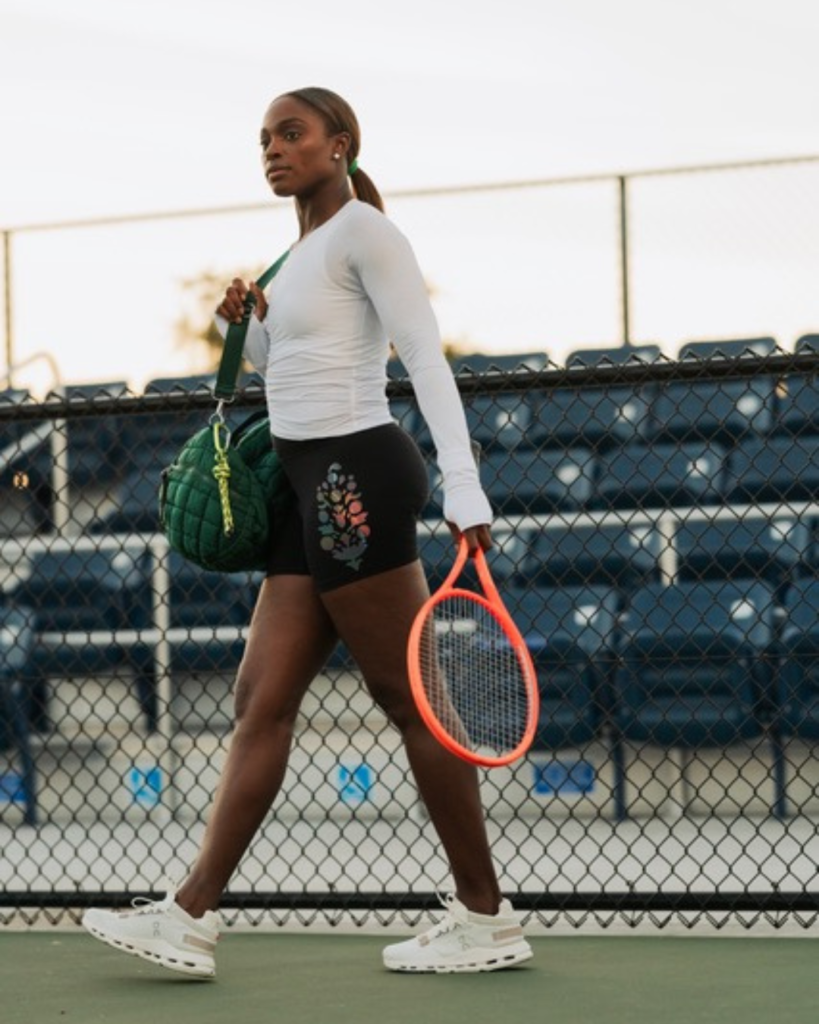
Her résumé reads like a master class in sustained excellence: Premier Mandatory champion in Miami, finalist at Roland Garros and the WTA Finals, clay-court titles in Guadalajara, Saint-Malo, and Rouen, and career prize money approaching $19 million. Even as new generations storm the rankings, Stephens remains the player no one wants in their quarter.
Stephens’s transition from athlete to entrepreneur wasn’t an afterthought; it was a strategic pivot. Pandemic protocols prevented players from showering at tournaments—an inconvenience that sparked an idea. “I needed portable, performance-grade products that kept me fresh between matches,” she recalls. Months of lab work yielded the No. 3161 Game-Changing Deodorant and 24/7 Hustle Body Mist, each stress-tested during preseason camps. “People realized this wasn’t a vanity line. It was built to work when your heart rate’s at 180.”
Early traction was no accident. Stephens arrived at buyer meetings with retail readiness—tight supply chains, transparent ingredient decks, and a brand story that linked sweat equity to self-care. “Retailers want founders who know their customer and solve a real problem,” she says. “Be ready before the door opens so that you can walk through with confidence.”
That philosophy echoes her court craft: disciplined preparation, in-match adaptability, long-game patience. “In tennis, you chase weekly wins; in business, you chase legacy. I had to zoom out,” she explains. “The scoreboard now is impact—how many lives we touch, how many routines we elevate.”
Stephens’s playbook offers hard-won wisdom for entrepreneurs: clarity beats complexity, teams amplify talent, and recovery is strategy. She structures her calendar around distinct lanes—training blocks, board meetings, media duties—and guards her rest day the way she guards break points. “Self-care isn’t bubble baths,” she laughs. “It’s boundaries, hydration, eight hours, therapy, ice baths—whatever keeps you whole.”

Her approach is resonating with consumers who see wellness as performance insurance, not vanity. Doc & Glo’s upcoming drop adds a cooling body scrub and luxe lotion, expanding what she calls “movement-driven wellness” into a full ecosystem. The long view? Hotel amenities deals, in-gym retail, and a scholarship fund that funnels profits back into underserved communities.
A decade before clean beauty, Stephens founded the Sloane Stephens Foundation to bring tennis and tutoring to Compton Unified School District. Today the program spans 25 schools, 50 refurbished courts, and more than 15,000 students served, earning honors from Sports Business Journal and the USTA Foundation. “Tennis gave me agency; now I pass that on,” she says. The foundation’s Love Love Compton initiative layers homework help atop forehands, proving sport can be both passport and pipeline.
Philanthropy, corporate strategy, elite sport—each lane feeds the next. Stephens balances them with the same mantra her grandfather whispered after early junior losses: You don’t have to win every time, but you do have to keep going.
As the WTA calendar rolls toward another US Open, Stephens is still grinding on hard courts—because greatness, for her, is not a single peak but a range of summits. Whether she’s flicking a cross-court winner or sealing a national retail deal, the through-line is agency. She owns the narrative Black women athletes have long rented: that excellence is multidimensional, that wealth can be wellness, and that legacy is best measured by the doors you pry open for others.
From center court to clean beauty aisles, Sloane Stephens remains the rare champion who can finish a point—and start a movement.